Maison
Chanel
Founded in 1910 in Paris by Gabrielle "Coco" Chanel (1883–1971), who opened her first millinery boutique at 21 rue Cambon. The atelier expanded into clothing through the 1910s and was consolidated as the House of Chanel by the early 1920s.
Creative director of fashion: Matthieu Blazy, since 2025. Chanel remains privately held by the Wertheimer family — brothers Alain and Gérard Wertheimer, grandsons of Coco Chanel's original business partner Pierre Wertheimer.
Volatile fields — verify creative-director and ownership lines against fresh sources before publishing.


Design DNA
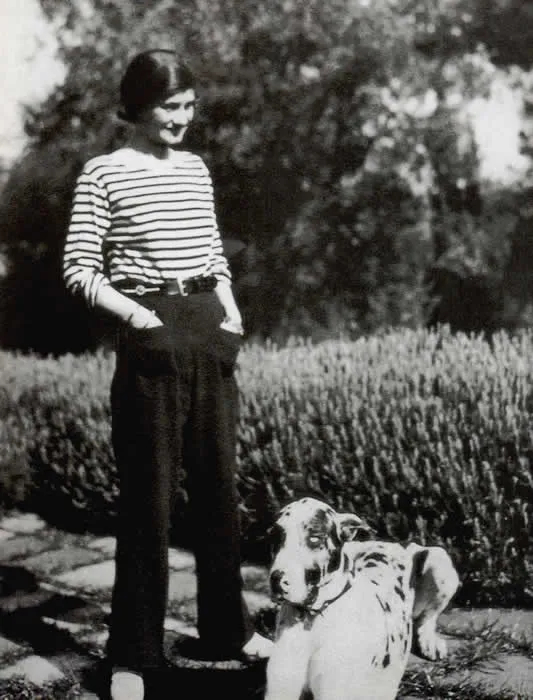
Tweed, jersey, and a black-and-white palette punctuated by gilt and pearl. The codes are reductive and architectural — the collarless cardigan jacket, the unembellished little black dress, the camellia, the interlocking-C monogram, costume pearls worn with day clothes, and the two-tone slingback — a vocabulary built to liberate the body rather than constrain it.
Cultural impact & collaborations
Coco Chanel reshaped twentieth-century womenswear by replacing corsetry with jersey and tailoring borrowed from menswear; the house's codes — tweed, pearls, the little black dress — are among the most quoted in fashion. Under Lagerfeld, Chanel became a benchmark for staged spectacle, with shows set in supermarkets, casinos, rocket launches, and recreated street scenes inside the Grand Palais. Recent collaborations span cinema, ballet (Pharrell Williams's pieces with Paris Opéra Ballet costumes), and the visual arts through the Métiers d'Art programme.
Beyond the timeline
A reason to exist beyond a timeline — the pieces that made Chanel Chanel.
- Chanel N°5 1921
The Chanel N°5 flacon · Photo: Arz / Wikimedia Commons · Public domain The aldehyde-led fragrance composed by Ernest Beaux, presented in a stark rectangular flacon often said to draw from men's whisky decanters and pharmaceutical glass. Coco picked the fifth sample Beaux brought her — the eponymous N°5 — and launched it on the fifth of May 1921. The first scent to carry a couturier's name, it remains, a century on, among the best-selling perfumes in the world. Marilyn Monroe's 1952 quip that she wore "a few drops of N°5" to bed sealed its place in popular culture; the house has since anchored the campaign with successive ambassadors from Catherine Deneuve to Nicole Kidman.
- The cardigan jacket 1925–
Collarless, braid-trimmed, weighted with a fine chain at the hem so it falls cleanly — the tweed silhouette that became shorthand for Parisian dressing.
- The little black dress 1926
A simple long-sleeved sheath in black crêpe de Chine photographed for American Vogue, which compared its anonymity and ubiquity to Henry Ford's Model T.
- The 2.55 bag 1955
A quilted leather shoulder bag with a chain strap that freed the wearer's hands — named for February 1955. The interlocking-C clasp came later, with Lagerfeld.
- The two-tone slingback 1957
Beige body, black toe cap. The beige lengthened the leg, the black cap shortened the appearance of the foot — Coco's rebuke to the all-black court shoe.
- Costume jewellery
Coco's most durable contribution outside dressmaking: she popularised non-precious bijoux de fantaisie — glass, paste, gilt metal, simulated pearls — and brought it into high fashion, establishing its aesthetic value independent of intrinsic material worth. She layered ropes of fake pearls with tweed in daylight and, just as deliberately, mixed costume pieces with real stones so the wearer (and the onlooker) could not always tell which was which. The 1932 Bijoux de Diamants collection was the calculated exception that proved the rule.
- Métiers d'Art shows 2002–
The annual pre-fall production conceived by Lagerfeld to showcase the in-house ateliers acquired under Paraffection — staged in cities (Edinburgh, Dallas, Salzburg, Dakar, Manchester) that frame the codes against new contexts.
- The J12 watch 2000
A high-tech ceramic sports watch in matte black or white — a rare instance of the house extending its design vocabulary into hard goods on its own terms.

Main product lines
- Haute couture — presented in Paris twice yearly
- Ready-to-wear — women's and, more recently, expanded accessories-led men's
- Métiers d'Art — annual pre-fall show celebrating the in-house ateliers
- Handbags & small leather goods
- Fragrance & beauty — led by N°5, Coco, Chance, Bleu de Chanel; cosmetics and skincare
- Fine jewellery & watches — Place Vendôme high-jewellery and the J12 watch line
- Eyewear, footwear, and accessories
Market positioning
Ultra-luxury. Chanel commands the highest tier of pricing in ready-to-wear and leather goods, anchored by haute couture credibility and a beauty-and-fragrance business of global scale.
Business scale
One of the largest privately-held luxury houses in the world, with annual revenues reported on the order of nineteen to twenty billion US dollars in recent years. Figures move; verify against the latest published accounts before citing.