Maison
Valentino
Founded in 1960 in Rome by Valentino Garavani (b. 1932) with his business and life partner Giancarlo Giammetti. Garavani had trained in Paris under Jean Dessès and Guy Laroche before opening the atelier on via Condotti, anchoring the house from the start in the language of Roman haute couture.
Creative director: Alessandro Michele, since March 2024, after sixteen years at the helm of Gucci. Valentino is majority-owned by Mayhoola for Investments (Qatar), with Kering holding a thirty-per-cent minority stake under a 2023 agreement that includes an option for full acquisition by 2028.
Volatile fields — verify creative-director and ownership lines against fresh sources before publishing; Michele's tenure and the Kering option are recent and still settling.


Design DNA
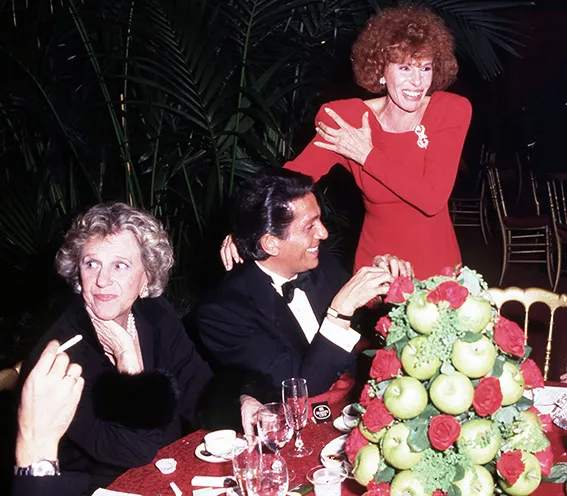
An Italian-couture sensibility built on the dialogue between rosso Valentino and ivory, between cinematic glamour and Roman craft. Garavani's vocabulary — sculptural draping, ruffled volants, lace, and hand-applied embellishment — was reframed under Piccioli into a language of saturated colour and modern proportion, then reframed again under Michele as an eclectic, archive-mining maximalism. The V-logo and the pyramid-studded Rockstud function as the house's most recognisable hard-good signatures.
Cultural impact & collaborations
Valentino Garavani's wardrobe has dressed the post-war public imagination of glamorous European femininity — from Jackie Kennedy's wedding to Skorpios in 1968 to decades of red-carpet appearances in rosso Valentino. Under Piccioli the house became a benchmark for the contemporary couture show as a chromatic statement and for an inclusive casting practice that reframed a heritage Roman maison for a younger audience. The Michele appointment, announced in March 2024, places one of the most stylistically distinctive directors of the previous decade at the head of the house — its working-out is still in progress.
Beyond the timeline
A reason to exist beyond a timeline — the pieces that made Valentino Valentino.
- The <em>Collezione Bianca</em> 1968
An entirely white spring couture collection — coats, day dresses, and evening gowns rendered in ivory, cream, and bone. The show became the house's most-quoted statement and the foundation of its enduring bridal vocabulary.
- <em>Rosso Valentino</em> 1959–
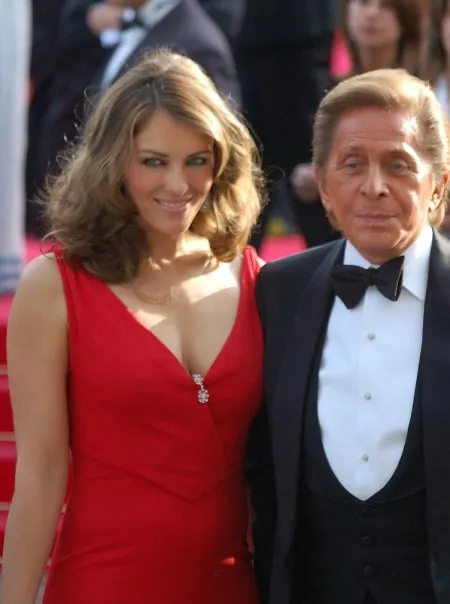
The saturated couture red Garavani has described as fixed from a single early epiphany at the opera in Barcelona. It is less a Pantone reference than a recurring runway leitmotif — the colour the house finishes a couture show on, worn by Jackie Onassis, Julia Roberts, and the better part of three generations of Oscar attendees.
- The V-logo 1985–
A geometric serif V introduced in the mid-1980s and since extended across hardware, buckles, and full-coverage monogram canvases — one of the most-recognised identity marks in Italian luxury.
- The Rockstud 2010–
Pyramid metal studs bordering bags, pumps, ballerinas, and sandals — the Chiuri-and-Piccioli accessory that became shorthand for a certain 2010s wardrobe and, briefly, the house's commercial centre of gravity.
- The Roman Stud 2020–
Piccioli's larger, softer evolution of the Rockstud — a maxi-stud quilted-leather shoulder bag introduced under his solo direction.
- Piccioli's chromatic couture 2017–2024
The Pierpaolo Piccioli era is most legible in the monochrome-saturated couture shows — pinks, oranges, acid greens, and cobalt staged against unadorned backdrops — that recentred the house on colour as a structural element rather than a finishing touch.
- Valentino Garavani retrospective 2007
A three-day Rome celebration around Garavani's retirement, including a couture show at the Temple of Venus and a retrospective exhibition at the Ara Pacis — closing the designer's forty-five-year tenure as a public spectacle in his adopted city.
Main product lines
- Valentino Haute Couture — presented in Paris twice yearly, anchored in Rome
- Ready-to-wear — women's and men's collections
- Handbags & small leather goods — anchored by the Rockstud, Roman Stud, and VLogo families
- Footwear — including the Rockstud pump and flat
- Fragrance & beauty — operated under licence and, more recently, brought partly in-house
- Eyewear and accessories
Market positioning
Ultra-luxury. Valentino sits in the top tier of Italian houses alongside Prada and Gucci, with haute-couture credibility anchoring a ready-to-wear and accessories business priced at the upper end of the segment.
Business scale
Annual revenues on the order of one-and-a-half billion euros in recent years (per Mayhoola-released figures, 2023), with a global retail network and growing direct-operated presence. Figures move; verify against the latest published accounts before citing.